Momentum Factor in Memory ETFs: The Smart Beta Test
2026-11-20

The relationship between memory markets and personal computer shipments offers a useful way to study the timing of semiconductor cycles. PCs remain one of the most visible end markets for DRAM, NAND, processors, storage devices, and a wide range of supporting components. Yet the equity market does not necessarily wait for shipment data to confirm a recovery. Memory-related indexes can begin moving months before hardware volumes visibly improve, reflecting expectations about inventories, pricing, production discipline, and future demand.
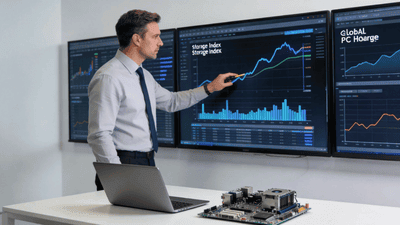
This creates an interesting framework for investors examining AI storage and computing power themed ETFs and index derivatives. A memory index can sometimes function as a market-based leading indicator for PC shipments, while PC shipment data can later provide fundamental confirmation of whether the anticipated semiconductor recovery is actually developing.
The relationship is not perfectly stable. AI servers, smartphones, enterprise storage, automotive electronics, and industrial applications now represent important sources of semiconductor demand. The PC market therefore no longer determines the entire memory cycle. Nevertheless, comparing memory-index behavior with PC shipment trends can reveal useful information about inventory normalization, component pricing, and changing expectations across the technology supply chain.
Personal computers remain an important consumer of memory and storage components. Each system requires some combination of DRAM, NAND-based storage, processors, controllers, and other semiconductor devices. Changes in PC production can therefore influence component demand even when the industry is experiencing strong growth from other applications.
The connection is especially relevant during inventory corrections. When PC manufacturers reduce orders, component suppliers may experience weaker utilization and pricing pressure. When PC demand stabilizes, customers can begin rebuilding inventories before retail shipments fully recover.
This creates a timing difference between the physical market and the financial market. PC shipments are generally observed after manufacturers have produced, distributed, and sold systems. Memory stocks, by contrast, trade continuously on expectations about what those future shipment numbers will mean for supply and pricing.
That timing gap is the foundation of the leading-indicator model.
Suppose PC shipments decline for several quarters. Manufacturers become cautious, inventories rise, and memory suppliers reduce production plans. At first, the outlook appears negative. Eventually, however, inventories begin to normalize and supply growth slows.
Equity investors may recognize this turning point before PC shipment statistics improve. Memory-related companies can begin to recover because investors anticipate better pricing and margins in the following quarters.
The index can therefore turn upward while PC shipments remain weak. The market is effectively pricing the next stage of the cycle rather than reporting the current stage.
This does not mean every rise in a memory index predicts stronger PC shipments. Financial markets can move for many reasons, including AI demand, liquidity conditions, currency movements, valuation changes, and expectations for other semiconductor markets. The relationship must therefore be interpreted within a broader framework.
A useful way to understand the model is to separate three timelines. The first is the physical demand timeline, represented by PC shipments and production. The second is the component timeline, represented by memory pricing, inventory, and supplier utilization. The third is the financial timeline, represented by semiconductor and memory indexes.
These timelines rarely move at exactly the same speed. PC shipments may remain weak while memory pricing begins to stabilize. Memory pricing may stabilize while semiconductor stocks rise in anticipation of margin recovery. Eventually, stronger shipment data may validate the earlier market movement.
This sequence creates the possibility of a leading relationship, but it also creates false signals. If the expected recovery does not materialize, the index can reverse before shipment data confirms the original thesis.
Inventory often explains more of the relationship between memory indexes and PC shipments than shipments alone. A decline in PC shipments does not necessarily produce immediate weakness in memory pricing if suppliers have already reduced output and channel inventories are low.
Likewise, stronger PC shipments do not automatically create strong memory pricing if manufacturers are carrying excessive inventories.
For this reason, a leading-indicator model should place inventory between the index and PC shipments. A simplified framework can be expressed conceptually as memory-index movement, inventory adjustment, component pricing, and eventual PC demand confirmation.
This is why memory stocks can sometimes rise before shipment growth becomes visible. Investors may be anticipating an inventory turning point rather than an immediate increase in end-user demand.
DRAM and NAND pricing can provide a more direct connection between memory equities and PC demand. When suppliers have excess inventory, pricing pressure can reduce revenue and margins even if shipment volumes remain relatively stable.
When inventory becomes more balanced, pricing can stabilize or improve before unit shipments increase significantly. Because memory companies are highly sensitive to pricing changes, their earnings expectations can respond quickly.
This makes memory pricing an important bridge between the index and PC shipments. A rising memory index accompanied by improving pricing can provide a stronger cyclical signal than a rising index alone.
Conversely, if memory equities rally while pricing continues to deteriorate, the market may be anticipating a future recovery that has not yet appeared in operating data. That can be an important distinction for ETF and index-derivative analysis.

The traditional memory cycle was heavily influenced by PCs and smartphones. The rise of AI computing has made the relationship more complex. High-performance computing systems require HBM, advanced DRAM, enterprise SSDs, networking memory, and large-scale storage.
AI infrastructure can therefore support memory demand even when PC shipments are weak. A memory index may rise because AI-related demand is accelerating, while PC shipment data remains stagnant.
This is not a failure of the leading-indicator model. It means that the model needs to distinguish between the traditional PC-driven memory cycle and the broader AI-driven memory cycle.
For AI storage and computing ETFs, this distinction is particularly important. A diversified semiconductor index may be influenced more by data-center spending than by consumer PC shipments, while a conventional memory index may retain greater sensitivity to DRAM and NAND pricing.
AI systems introduce another interesting feature: memory intensity per computing system can be substantially higher than in conventional computing applications. Advanced accelerators rely heavily on high-bandwidth memory, while large AI clusters require significant storage capacity and data movement infrastructure.
This means that a relatively modest change in AI server deployments can potentially generate substantial demand for specific memory products.
As a result, investors should avoid using PC shipments as the sole leading indicator for the entire memory sector. PC shipments can still provide valuable information about conventional demand, but the AI infrastructure cycle can move independently.
A more comprehensive model therefore separates consumer computing from AI computing. The memory index becomes a composite reflection of both cycles, with their relative importance changing over time.
Imagine a period in which global PC shipments remain under pressure, but the memory index begins a sustained advance. At first, the divergence may appear contradictory.
One explanation is inventory normalization. PC manufacturers may still be cautious, but memory suppliers could have already reduced production sufficiently to stabilize the supply-demand balance.
Another explanation is AI demand. Strong HBM and enterprise storage demand may offset weak consumer electronics demand for selected memory manufacturers.
A third explanation is valuation. Memory stocks may have fallen so far during the previous downturn that investors begin pricing a future recovery even before current shipment data improves.
The divergence therefore requires interpretation rather than an immediate conclusion that one of the indicators is wrong.
The reverse situation can also occur. PC shipments may begin improving while memory stocks remain weak.
This could happen if the market believes the shipment recovery is temporary or insufficient to eliminate excess inventory. It could also occur if memory suppliers have already expanded production too aggressively, limiting the impact of higher unit demand on pricing.
Another possibility is that investors are focused on a stronger AI or data-center opportunity elsewhere in the semiconductor sector. In that case, PC-related memory demand may improve without producing a major revaluation of the broader memory index.
This demonstrates why shipment data should be interpreted together with pricing and supply discipline.
A practical model can begin with the memory index as the market-based variable and PC shipments as the fundamental confirmation variable. Between them, several intermediate indicators can be introduced.
Inventory provides information about supply-chain health. DRAM and NAND pricing provides information about the balance between supply and demand. Supplier utilization provides insight into production discipline. Capital expenditure indicates future capacity. AI server investment provides a separate source of structural memory demand.
The resulting framework is less about predicting a precise month for a PC recovery and more about identifying whether the semiconductor cycle is moving from contraction toward stabilization, recovery, or renewed oversupply.
For example, a constructive combination could involve improving memory-stock performance, stabilizing memory prices, declining inventories, and gradually improving PC orders. A less convincing signal might involve rising memory stocks without any improvement in pricing or inventory conditions.
Leading indicators are often described using fixed time windows, but semiconductor cycles rarely follow a perfectly consistent schedule. The interval between stock-market movement and physical demand can change depending on inventory levels, supply discipline, macroeconomic conditions, and the strength of the previous downturn.
During a severe inventory correction, financial markets may turn months before shipments recover. During a supply-constrained environment, the lag can become much shorter because pricing responds immediately to shortages.
AI infrastructure introduces additional variability because accelerator and memory demand can expand independently of consumer electronics.
Therefore, the leading-indicator model is better treated as a flexible relationship than a mechanical calendar.
For investors analyzing AI storage ETFs, the PC shipment relationship can provide useful context but should not be treated as a direct valuation formula.
An ETF containing memory manufacturers, storage companies, semiconductor equipment providers, and AI infrastructure businesses may have several different demand drivers. PC shipments could influence part of the portfolio, while AI servers, enterprise storage, cloud investment, and advanced packaging influence other components.
The more diversified the ETF, the less useful a single end-market indicator becomes. Investors should examine which constituents are most sensitive to PCs and which are more directly connected to AI infrastructure.
This is particularly important for index derivatives. Options and futures may respond to the overall index rather than the specific fundamental variable being studied. A strong PC recovery could therefore have only a limited effect if the index is dominated by AI infrastructure companies.
One of the most useful features of the model is divergence. When the memory index and PC shipments move in different directions, the gap itself can provide information.
A rising index with weak shipments may indicate that investors are looking beyond current consumer demand toward pricing recovery, AI demand, or supply discipline. A falling index despite improving shipments may suggest concerns about margins, capacity expansion, valuation, or broader macroeconomic conditions.
Neither divergence automatically produces a bullish or bearish conclusion. Instead, it identifies a period when expectations and reported fundamentals are moving at different speeds.
That is often where the most interesting research begins.
The leading-indicator model can also be combined with technical analysis. A memory index breaking above a long consolidation range while memory pricing stabilizes and PC inventories normalize represents a different signal from an index rising solely because of broad market momentum.
Similarly, a breakdown below a major technical support level accompanied by weaker pricing and rising inventories may indicate that the market is reassessing the semiconductor cycle more fundamentally.
For ETF and index derivatives, this combination can be particularly useful because technical levels help identify changes in market positioning while shipment and pricing data provide economic context.
No leading-indicator framework works consistently under every market condition. A major macroeconomic shock can overwhelm industry-specific signals. Currency movements can affect semiconductor-company earnings independently of shipment volumes. Supply disruptions can change memory pricing even when demand is unchanged.
AI infrastructure is another source of model instability. If AI-related demand becomes large enough relative to PC demand, the historical relationship between PC shipments and memory indexes can weaken substantially.
There is also a valuation problem. Equity markets can anticipate recovery so early that stocks move significantly before the fundamental improvement appears. If the recovery later arrives exactly as expected, the stock may still perform modestly because the information was already priced in.
The relationship between a memory index and PC shipments provides a useful framework for understanding how semiconductor markets price the future. Memory-related equities can often react before shipment statistics confirm a recovery because investors are responding to changes in inventory, pricing, supply discipline, and expected earnings.
For AI storage and computing power themed ETFs and index derivatives, the model becomes more nuanced because AI infrastructure has created a second major source of memory demand. PC shipments remain relevant, particularly for conventional DRAM and storage, but they no longer explain the entire memory cycle.
The most useful approach is therefore to treat the memory index as a market-expectations indicator and PC shipments as one component of fundamental confirmation. Inventory, DRAM and NAND pricing, capital expenditure, HBM demand, AI server deployments, and semiconductor utilization can fill the gap between the two.
When the memory index leads PC shipments in a consistent direction, the relationship can provide valuable information about the market's expectations. When the two diverge, the divergence may be even more informative, revealing whether investors are looking beyond consumer computing toward AI infrastructure or questioning the sustainability of an anticipated recovery.
Ultimately, the leading-indicator model is not about finding a fixed number of months between the stock market and PC shipments. It is about understanding how expectations travel through the semiconductor ecosystem. In an industry increasingly shaped by both conventional computing and AI infrastructure, that distinction is becoming central to interpreting memory indexes, thematic ETFs, and the derivatives linked to them.